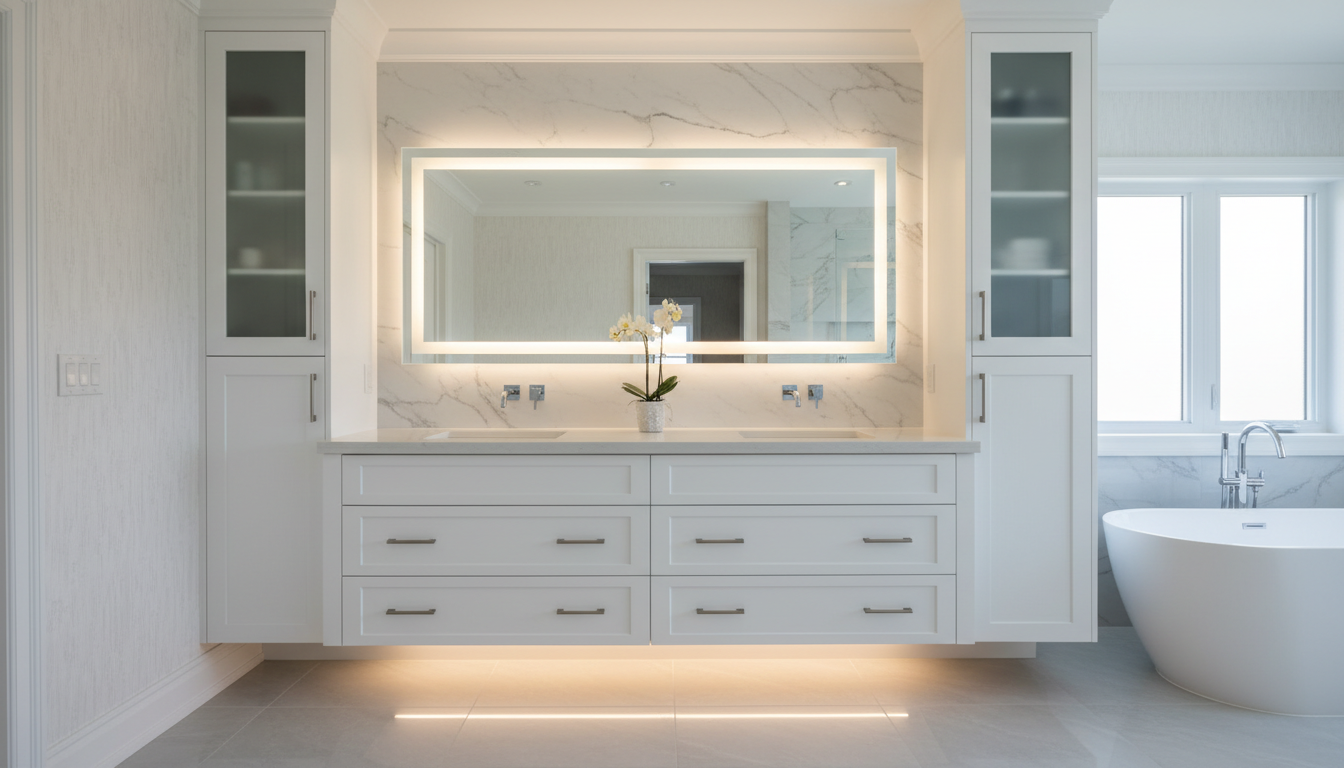
Shaker and flat-front (slab) are the two dominant kitchen cabinet door styles in Canadian residential design. Everything else — raised panel, glass insert, beadboard — is a variation on one or the other. Choosing between them isn’t a matter of one being better; it’s a matter of which fits your kitchen’s direction.
What Is a Shaker Door?
A shaker door has a five-piece construction: a flat centre panel recessed inside a four-piece frame (two rails, two stiles). The resulting profile creates a visible inset rectangle — the defining feature of shaker cabinetry. The frame depth of the recess varies; a deep recess (3/8″ to 1/2″) reads as traditional; a shallow recess reads as transitional or contemporary.
Shaker is the most common cabinet door style in GTA North residential kitchens. It works across design directions — from farmhouse to transitional to modern transitional — which explains its dominance in a market where resale appeal matters. If you’re not sure what door style to choose, shaker is the safe choice because it works with nearly every countertop, hardware, and colour combination.
What Is a Flat-Front (Slab) Door?
A flat-front or slab door is a single panel with no frame, no profile, and no recessed centre. The entire door face is one continuous flat surface. In a painted finish, this reads as clean and minimal. In a wood-grain finish, the lack of frame lets the grain pattern speak without interruption.
Flat-front cabinets are the dominant style in modern and contemporary kitchens — particularly in high-gloss lacquer, matte lacquer, or integrated-handle (handleless) configurations. They require more precise manufacturing because there’s nowhere to hide a warped panel or uneven finish, and they’re more demanding to keep fingerprint-free than a shaker door where the frame breaks up the surface.
Side-by-Side Comparison
| Factor | Shaker | Flat-Front (Slab) |
|---|---|---|
| Design direction | Traditional, transitional, farmhouse, modern transitional | Modern, contemporary, minimalist |
| Hardware requirement | Works with or without hardware (cup pulls, bar pulls, knobs) | Often handleless (integrated groove or push-open) or long bar pulls |
| Fingerprints | Frame breaks up surface — less visible | Shows fingerprints more on painted/gloss finishes |
| Cleaning | Frame recesses trap grease and require detail cleaning | Single flat surface — wipes down in one pass |
| GTA North resale | Very broad buyer appeal | Strong in design-forward properties; narrower pool |
| Cost difference | Standard — baseline pricing | 10–15% more in lacquer or high-gloss finishes |
| Manufacturing tolerance | Frame structure accommodates minor panel variation | Requires tighter production — no frame to absorb error |
Which Kitchen Design Directions Use Shaker
- Transitional: Shaker’s most natural home. Transitional kitchens blend traditional structure (the door frame) with contemporary colour, hardware, and countertop choices
- Farmhouse: Shaker with natural wood, white or greige paint, and cup pulls or simple bar pulls is the foundation of GTA North farmhouse-style kitchens
- Modern transitional: A shallow-recess shaker in a navy, forest green, or greige reads contemporary — the frame adds interest without traditional visual weight
- Classic/traditional: Deep-recess shaker with raised-arch detail, crown moulding, and knob hardware
Which Kitchen Design Directions Use Flat-Front
- Full modern: Flat-front in matte lacquer, integrated handles, and a monochromatic countertop/cabinet scheme
- Scandinavian minimal: Flat-front in a light wood grain (oak, ash) with minimal hardware
- High-contrast contemporary: Flat-front off-black or deep charcoal lowers with white quartz countertop — a sharp, architectural look
Can You Mix Shaker and Flat-Front?
Yes — and it’s increasingly common. A popular GTA North kitchen treatment is shaker perimeter cabinets in a painted colour with flat-front island panels (or vice versa). The contrast between door styles adds layered design interest without requiring two different colour treatments. DKC produces mixed-door kitchens regularly and designs them so the proportional split looks intentional rather than accidental.
Want to see shaker and flat-front door samples in your kitchen?
DKC brings physical door samples to in-home consultations and produces a 3D rendering showing your kitchen in both styles before you decide. Free consultation — Vaughan and GTA North.
Book My Free Kitchen Door Style ConsultationFrequently Asked Questions
Are shaker cabinets going out of style in Canada?
No — shaker is the dominant door style in Canadian residential kitchens and has been for over a decade. It works across design directions (farmhouse, transitional, modern transitional) and has the widest resale appeal in GTA North. Updated colours and hardware keep shaker current without requiring a door style change.
Do flat-front cabinets cost more than shaker?
Standard flat-front costs similarly to shaker. The premium comes with high-gloss lacquer or polyurethane finishes — typically 10–15% more than an equivalent painted shaker door.
Free kitchen door style consultation — Vaughan and GTA North.
DKC brings physical samples to your home and produces a 3D rendering in both styles — shaker and flat-front — so you can compare them in your actual kitchen before committing.
Book My Free Kitchen ConsultationRelated: Custom Kitchen Cabinets Vaughan (HUB) | Shaker Kitchen Cabinets Vaughan | Kitchen Cabinet Door Styles Guide
nnReady to Transform Your Home?
n780+ GTA North homeowners trust DKC Wooden Cabinetry. Free in-home consultation. 3D design presentation. 10-year workmanship warranty. In-house manufacturing and installation.
nExplore DKC Custom Cabinetry Services in Vaughan & GTA North:
nReady to Transform Your Home?
780+ GTA North homeowners trust DKC Wooden Cabinetry. Furniture-grade plywood. 3D design. 10-year workmanship warranty.
Get My Free Design Consultation