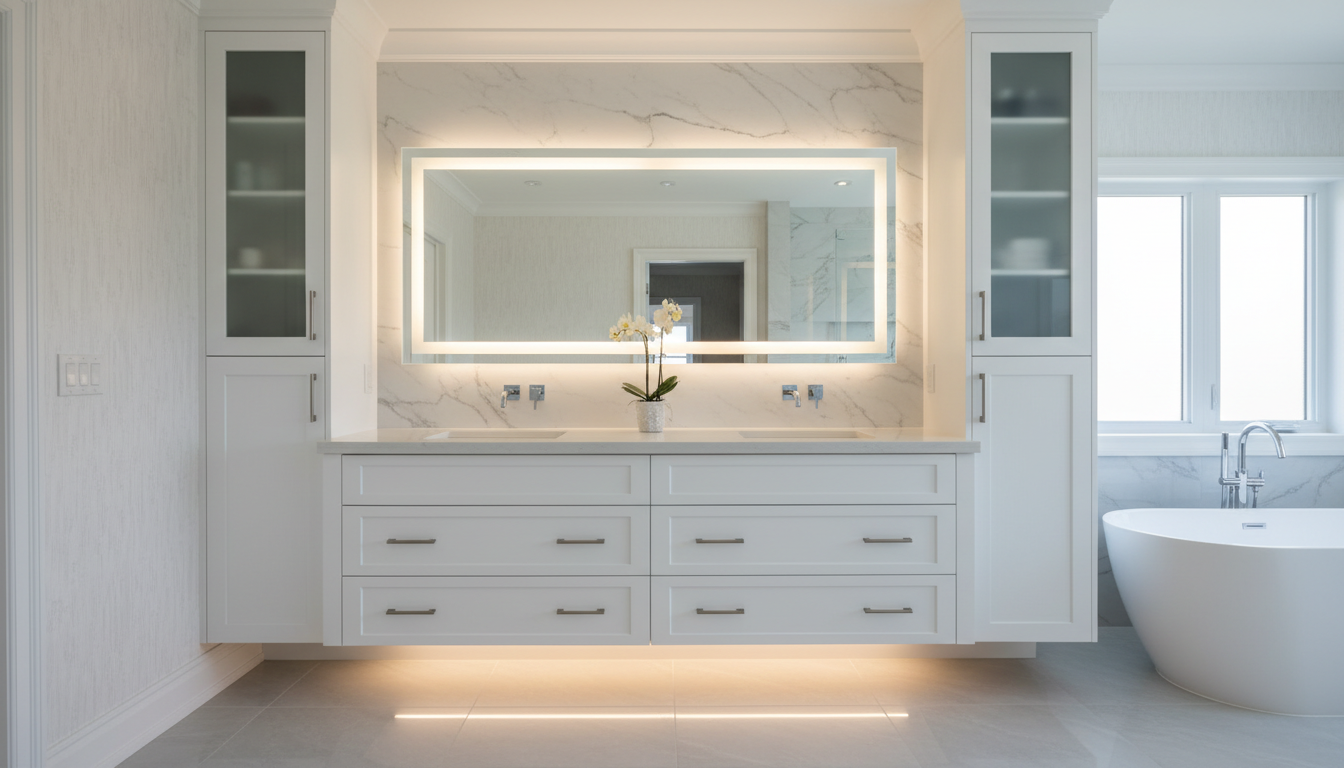
The material you choose for your home office cabinets determines how they look, how long they last, how they hold screws and hinges over time, and what they cost. There are four main materials used in custom home office cabinetry in the GTA — each with a distinct performance profile. Here’s what cabinet makers actually use and why.
The 4 Main Materials for Home Office Cabinets
1. Furniture-Grade Plywood (DKC Standard)
Furniture-grade plywood is the premium structural material for home office cabinetry — and the material DKC uses for all cabinet boxes. Birch core or maple core plywood (typically 3/4″) is dimensionally stable, holds screws and cam locks reliably over decades, and does not sag under heavy book loads the way MDF does on long shelf spans. It’s also significantly lighter than MDF for equivalent thickness, which matters in tall floor-to-ceiling installations where cabinet weight accumulates.
Pros: Strong screw-holding, dimensionally stable, lighter than MDF, resists sag on long spans, holds up to humidity fluctuations better than MDF
Cons: More expensive than MDF; edge grain must be covered with edge banding or solid wood trim; not completely smooth on face (veneer core has slight texture compared to MDF face)
Best for: All structural cabinet boxes (sides, tops, bottoms, shelves, backs)
2. MDF (Medium-Density Fiberboard)
MDF is an engineered wood product made from wood fibers and resin, pressed into a dense, smooth sheet. It paints exceptionally well — the smooth, consistent face takes paint with no grain telegraphing through the finish — which is why it’s the standard material for painted cabinet doors and drawer fronts in the GTA market. Most “painted cabinetry” you see in home office photos uses MDF doors on plywood box construction.
Pros: Extremely smooth surface for painted finishes, consistent density (no grain variation), less expensive than plywood, easy to route and shape for door profiles
Cons: Heavy; does not hold screws as well as plywood (especially at edges); sags on long shelf spans; expands when exposed to moisture; cannot be easily refinished after damage
Best for: Cabinet doors, drawer fronts, painted panels, short shelf spans where weight is not a concern
3. Solid Wood
Solid wood (maple, white oak, walnut, cherry) is used for desk surfaces, face frames, and door profiles in premium home office cabinetry. A solid wood desk surface is the most durable and visually premium option for the primary work surface — it can be sanded and refinished after scratches and dents, lasts decades, and reads as clearly higher quality than laminate or MDF alternatives. However, solid wood moves with seasonal humidity changes — a property that must be accounted for in the design of long spans and wide panels.
Pros: Maximum durability; refinishable; premium visual quality; strong screw-holding; unique grain character in each piece
Cons: Most expensive option; seasonal movement must be managed in wide panels; requires finishing (stain + topcoat) that adds to lead time and cost
Best for: Desk surfaces, face frames, door fronts in natural wood finish offices
4. Melamine / Laminate
Melamine is a paper overlay (printed with a wood grain or solid colour pattern) thermally fused to a particleboard or MDF substrate. It’s the most cost-effective option and widely used in modular office furniture systems. It comes in dozens of finishes — white, grey, wood-look, and dark tones — and requires no painting. High-pressure laminate (HPL) is a thicker, more durable version often used for desk surfaces in commercial and heavy-use applications.
Pros: Most cost-effective; no painting required; wide range of colours and wood-look finishes; durable surface that resists scratches
Cons: Cannot be refinished; particleboard substrate has the worst screw-holding of all options; chips or peels at edges if impacted; looks less premium than solid wood or painted MDF
Best for: Shelf interiors (where finish is hidden), cost-sensitive secondary storage, HPL desk surfaces in commercial applications
Material Comparison Table
| Material | Durability | Finish Quality | Screw Holding | Relative Cost |
|---|---|---|---|---|
| Furniture-grade plywood | ★★★★★ | ★★★★ | ★★★★★ | $$$ |
| MDF | ★★★ | ★★★★★ (painted) | ★★★ | $$ |
| Solid wood | ★★★★★ | ★★★★★ | ★★★★★ | $$$$ |
| Melamine / laminate | ★★★ | ★★★ | ★★ (particleboard) | $ |
What DKC Uses (and Why)
DKC builds all home office cabinet boxes from furniture-grade plywood (3/4″ birch). Doors and drawer fronts are MDF for painted finishes, or solid wood for natural stain finishes. Desk surfaces are available in solid maple, white oak, walnut, or HPL. This combination — plywood box, MDF or solid wood fronts, solid wood or HPL desk surface — gives the best performance-to-cost ratio for a custom home office that’s built to last 20–30+ years.
DKC uses furniture-grade plywood for all cabinet boxes — no particleboard shortcuts.
Free in-home consultation and 3D design for your home office. Vaughan and GTA North.
Book My Free Home Office ConsultationCustom home office cabinetry — furniture-grade plywood, no shortcuts.
Free in-home consultation. 3D design. Vaughan and GTA North. 10-year workmanship warranty.
Book My Free Home Office ConsultationReady to Transform Your Home?
n780+ GTA North homeowners trust DKC Wooden Cabinetry. Free in-home consultation. 3D design presentation. 10-year workmanship warranty. In-house manufacturing and installation.
nExplore DKC Custom Cabinetry Services in Vaughan & GTA North:
nReady to Transform Your Home?
780+ GTA North homeowners trust DKC Wooden Cabinetry. Furniture-grade plywood. 3D design. 10-year workmanship warranty.
Get My Free Design Consultation