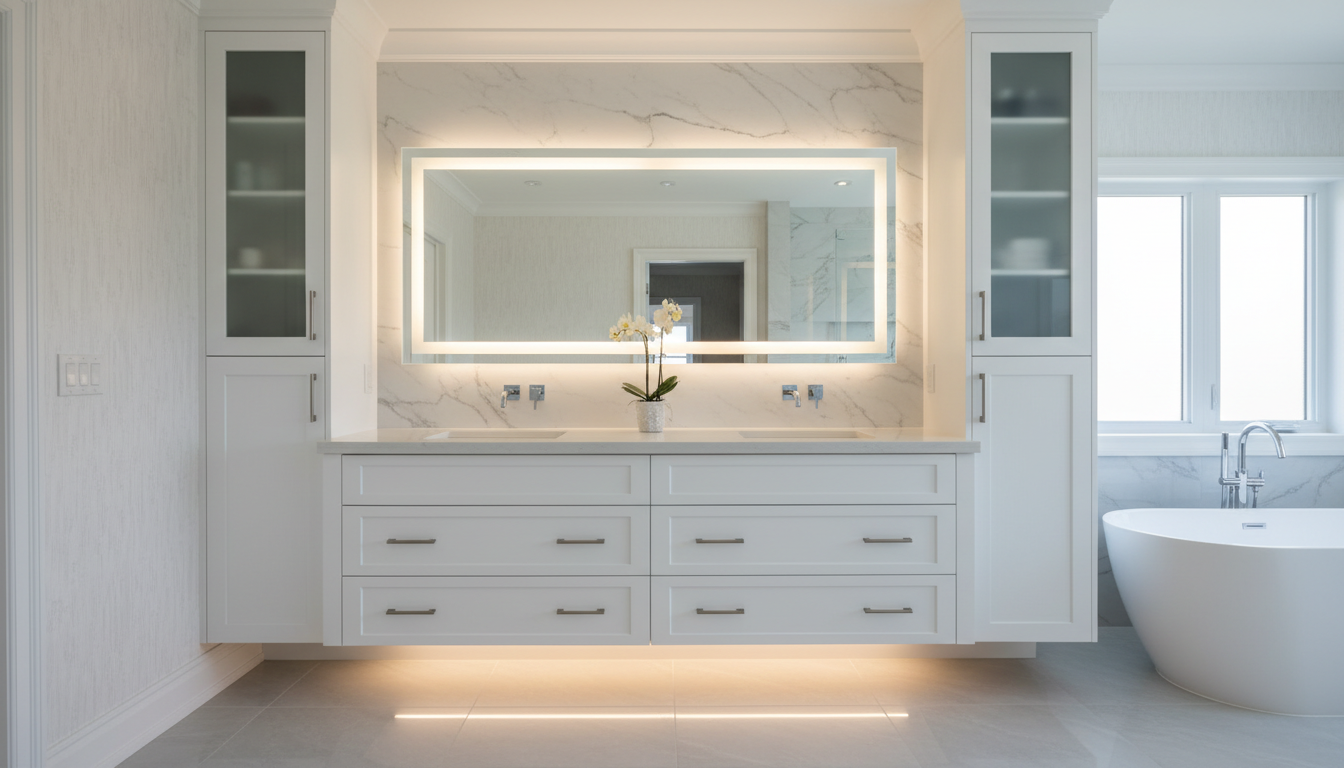
Custom kitchen cabinets are not pulled from a warehouse shelf. Every cabinet is engineered, cut, assembled, and finished specifically for your kitchen — and each step in that process is a direct reason why custom work lasts 25–50 years when stock cabinets last 10–15.
Here is the complete process — the 8 steps DKC Wooden Cabinetry follows on every kitchen in Vaughan and GTA North, with an honest explanation of what happens at each stage and why it matters for your finished kitchen.
Timeline: How Long Does It Take?
| Phase | Duration | What Happens |
|---|---|---|
| Design & approval | 2–3 weeks | Field measurement → 3D design → client sign-off |
| Production | 4–6 weeks | CNC cutting → assembly → finishing → QC |
| Delivery & install | 1–2 weeks | Delivery, acclimation, installation by DKC team |
| Total | 8–12 weeks | First consultation to installed kitchen |
Step 1: In-Home Field Measurement
Every custom kitchen project begins with a designer visiting your home — not a phone call, not homeowner-provided measurements. Field measurement is the most critical step because a 1/4-inch error here produces a visible installation problem.
The DKC designer measures every wall-to-wall, ceiling height at multiple points (older Vaughan homes are rarely perfectly level), all appliance openings, window sill heights, corner angles, and any obstructions — electrical panels, gas lines, plumbing rough-ins — that affect cabinet placement. Everything recorded in the design software during the visit.
Step 2: 3D Design and Client Approval
Field measurements feed directly into design software to produce a full-colour 3D rendering of your kitchen — showing cabinet layout, door style, finish colour, and interior storage from any angle. You review, request changes, and approve in writing. Production does not begin until sign-off.
This step is where most expensive errors are caught. An appliance that doesn’t fit, a corner that blocks a walkway, a drawer bank that conflicts with the dishwasher door swing — all visible in 3D before a single panel is cut.
Step 3: CNC Cutting — Where Precision Happens
Once the design is approved, a production file loads into a CNC (computer numerical control) saw. The CNC cuts furniture-grade 3/4-inch plywood panels to exact dimensions — accurate to within 0.5mm — with no hand-cutting variation. Every panel is cut to the exact size of your kitchen, not rounded to the nearest standard stock width.
What you’re paying for at this step: The CNC file is built from your kitchen’s actual field measurements. The plywood being cut is furniture-grade — 7-ply minimum, no voids — not the particleboard used in most stock cabinets. These two factors account for the majority of the price premium and almost all of the durability difference.
Step 4: Edge Banding
Raw plywood edges absorb moisture, swell, and delaminate — a significant problem in kitchens where steam, spills, and daily cleaning are routine. Edge banding seals every raw edge with a 2mm heat-bonded strip matched to the face finish. In stock cabinetry, thin iron-on edge strips typically peel within 3–5 years. Quality custom edge banding outlasts the panel itself.
Step 5: Box Assembly and Squaring
Cabinet boxes are assembled using dowel joints and wood glue, clamped under pressure while the glue cures. Each box is checked for square with a precision square before moving forward — an out-of-square box produces uneven door reveals and drawers that won’t close cleanly.
Drawer boxes are built separately with dovetail joinery. A dovetail joint is mechanically interlocked — it resists separation even without glue. Every drawer-opening cycle applies lateral stress to the joints. Dovetail handles that stress indefinitely. Staple-and-glue construction (standard in stock cabinets) does not.
Step 6: Door and Drawer Production
Doors are cut from solid wood (for stained finishes) or MDF (for painted finishes), routed to the selected profile — shaker, raised-panel, or flat slab — then sanded through multiple grits. Painted doors receive a primer coat before final sanding and topcoat. Soft-close hinges and full-extension drawer slides are fitted at this stage.
Full-extension slides allow complete drawer access — the full depth of the drawer is usable. Most stock cabinetry uses 3/4-extension slides, leaving the back 6 inches of every drawer permanently inaccessible behind the face frame.
Step 7: Finishing
All cabinet components are finished in a controlled spray environment — not a workshop open to dust and temperature swings. Environmental control is what separates a smooth, durable topcoat from a finish with dust nibs, fish-eyes, or orange-peel texture. Stained cabinets receive stain, sealer, sanding, and 2–3 topcoats. Painted cabinets receive primer, sanding, and two topcoats.
Step 8: QC, Labelling, Delivery, and Installation
Before any cabinet leaves the DKC workshop, it is inspected against the approved design drawings — dimensions checked, doors and drawers fitted and adjusted, finish reviewed, hardware confirmed. Cabinets that fail inspection are refinished or rebuilt.
Approved cabinets are individually wrapped and labelled by room position (upper-left, island-left, pantry-right) so the installation team knows exactly where each cabinet belongs on site. DKC’s in-house installation team — not subcontractors — delivers and installs every kitchen, with field adjustments included. Installation typically takes 2–3 days for a full kitchen.
Ready to start your custom kitchen cabinet project in Vaughan?
Book a free in-home consultation. Our designer visits, measures your kitchen, and delivers the first 3D design — no charge, no commitment.
Book My Free ConsultationFrequently Asked Questions
How long does it take to make custom kitchen cabinets in Ontario?
8–12 weeks total: 2–3 weeks design and approval, 4–6 weeks production, 1–2 weeks delivery and installation. Book your consultation at least 10–12 weeks before your target completion date.
What wood is used in custom kitchen cabinets?
Cabinet boxes: furniture-grade 3/4″ plywood (maple or birch, no voids). Doors: solid wood (maple, oak, walnut, cherry) for stained finishes, or MDF for painted finishes. Stock cabinets typically use particleboard — lower moisture resistance, shorter lifespan.
What is CNC cutting in cabinet making?
A computer-controlled saw cuts panels to exact dimensions (accurate to 0.5mm) from digital files built on your field measurements. No hand-cutting variation, no rounding to standard stock sizes — every panel is cut specifically for your kitchen.
Why are custom cabinets more expensive than stock?
Better materials (furniture-grade plywood vs particleboard), CNC precision manufacturing, skilled labour (field measurement, 3D design, dovetail joinery, controlled finishing), and in-house installation. These are the same reasons custom cabinets last 25–50 years when stock lasts 10–15.
Now you know the process — ready to start your kitchen?
DKC Wooden Cabinetry offers free in-home consultations in Vaughan, Woodbridge, Maple, Thornhill, Aurora, Richmond Hill, and GTA North. Step 1 — field measurement — is always free.
Start My Free Kitchen ConsultationRelated: What Are Custom Kitchen Cabinets? Complete Guide | Custom vs Stock Kitchen Cabinets | Custom Kitchen Cabinets Vaughan — HUB
nnExplore DKC Custom Cabinetry Services in Vaughan & GTA North:
nReady to Transform Your Home?
780+ GTA North homeowners trust DKC Wooden Cabinetry. Furniture-grade plywood. 3D design. 10-year workmanship warranty.
Get My Free Design Consultation