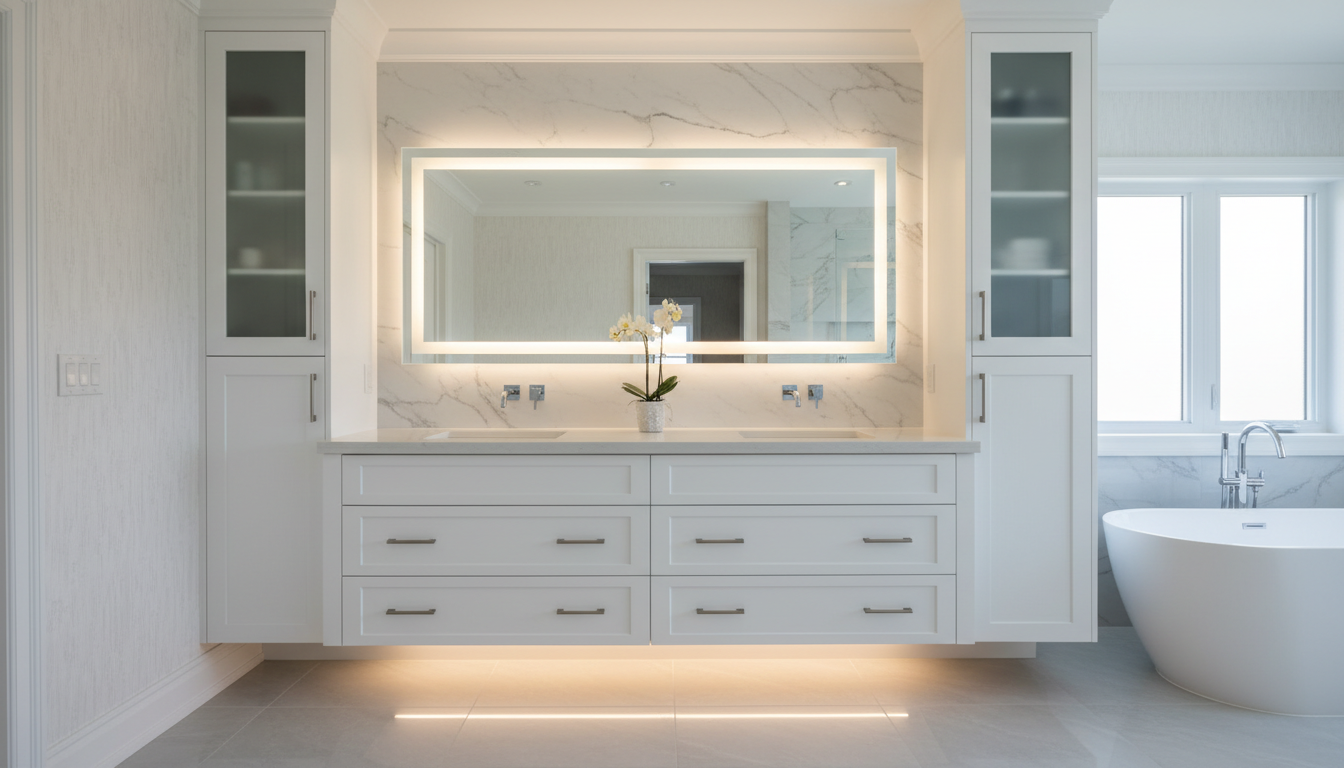
The single biggest factor affecting how long your kitchen cabinets last — and why some cabinet quotes are 2× higher than others for the same layout — is the material used for the cabinet box. Solid wood, plywood, and MDF each have specific strengths, specific weaknesses, and specific applications where they perform best.
Here is an honest breakdown of each material — what it is, how it performs in a kitchen environment, what it costs, and where DKC uses each one in the kitchens we build for Vaughan and GTA North homeowners.
The Three Main Cabinet Materials: Quick Comparison
| Property | Solid Wood | Plywood | MDF |
|---|---|---|---|
| Structural strength | Excellent | Excellent | Moderate |
| Moisture resistance | Moderate (expands/contracts) | Very good | Poor (swells badly) |
| Screw-holding | Excellent | Excellent | Poor (strips easily) |
| Paint finish quality | Good (grain may show) | Good | Excellent (ultra-smooth) |
| Weight | Heavy | Moderate | Heavy |
| Cost (relative) | Highest | Mid-high | Lower |
| Best use in cabinets | Doors, face frames | Cabinet boxes | Painted doors, large flat panels |
Solid Wood for Kitchen Cabinets
Solid wood is the premium material most homeowners picture when they think “quality cabinetry.” It is exactly what it sounds like: boards cut from a single species of tree — maple, oak, walnut, cherry, or hickory — with no lamination or engineered core.
Where solid wood excels
- Door and face frame construction: Solid wood is ideal for doors and face frames where grain character, staining depth, and structural integrity across wide panels matter
- Longevity: Properly finished solid wood doors last 30–50+ years without delamination risk
- Repair and refinishing: Solid wood can be sanded and refinished multiple times; veneer and laminate cannot
Where solid wood has limitations
- Cabinet boxes: Solid wood expands and contracts with humidity changes — a significant problem in kitchen environments where steam is constant. Wide solid wood panels used for box sides can warp or crack at joints over time
- Cost: Solid wood throughout (including box construction) is the most expensive option and is rarely justified for box panels where plywood performs equally or better
- Painting: Solid wood grain can telegraph through painted finishes, especially on wider panels
Common species in GTA North kitchens
| Wood Species | Character | Best For |
|---|---|---|
| Hard maple | Fine, consistent grain; takes paint and stain evenly | Painted kitchens, transitional style |
| White oak | Pronounced ray fleck grain; warm, contemporary feel | Natural stain, modern-traditional hybrid |
| Walnut | Rich dark brown, dramatic grain variation | High-end contemporary or traditional |
| Cherry | Reddish warmth, darkens over time with light exposure | Traditional, transitional kitchens |
Plywood for Kitchen Cabinets (The Professional Standard)
Furniture-grade plywood is the professional standard for custom kitchen cabinet boxes — and for good reason. Plywood is manufactured by laminating thin wood veneers in alternating grain directions, bonded under pressure. The cross-grain construction creates a panel that is dimensionally stable, resists moisture far better than solid wood in wide panels, and holds screws and fasteners reliably throughout its lifetime.
Quality markers to ask for:
- 3/4 inch (19mm) thickness for box sides, shelves, and bottom panels
- 7-ply or greater (more plies = more stability)
- No-void core — voids in the inner plies create weak spots where screws pull through
- Cabinet-grade or furniture-grade rating — not construction-grade
DKC uses furniture-grade 3/4-inch plywood for all cabinet box construction. This is why DKC kitchens carry a 10-year workmanship warranty — plywood box construction does not fail under normal kitchen conditions within that timeframe.
MDF for Kitchen Cabinets
MDF (medium-density fiberboard) is an engineered wood product made from compressed wood fibres and resin. It has a perfectly smooth, consistent surface — which is why it takes painted finishes better than any solid wood or plywood — but it has significant weaknesses in kitchen environments.
Where MDF works well
- Painted cabinet doors: MDF’s smooth surface eliminates grain telegraphing in painted finishes. For a flawless, factory-smooth painted door — especially on flat-panel and shaker profiles — MDF outperforms solid wood
- Routed profiles: MDF holds crisp, clean routed edges better than solid wood on complex door profiles
- Large flat panels: MDF is dimensionally stable for large, flat, painted panels that would be prohibitively expensive in solid wood
Where MDF fails in kitchens
- Cabinet boxes: MDF swells and delaminate rapidly when exposed to water — a single significant leak or steam exposure can destroy a particleboard or MDF cabinet box permanently
- Screw retention: MDF’s compressed fibre structure does not hold screws as reliably as plywood, especially at hinges and drawer slides where repeated stress cycles apply
- Weight: MDF is heavier than plywood for the same thickness, adding structural load to wall-mounted upper cabinets
What DKC Uses — and Why
DKC uses each material where it performs best:
- Cabinet boxes: 3/4-inch furniture-grade plywood — structural, moisture-resistant, excellent screw retention
- Doors (stained finishes): Solid wood species selected by the client — maple, oak, walnut, or cherry
- Doors (painted finishes): MDF — smoothest painted surface available, holds crisp routed profiles
- Face frames: Solid wood — structural, consistent, matches door species
- Drawer boxes: Solid wood with dovetail joinery — strongest drawer construction method available
Questions about which materials are right for your kitchen?
Book a free in-home consultation. We’ll review your kitchen, your budget, and your style preferences — and recommend exactly which materials make sense for your project, without upselling beyond what you need.
Get My Free Material ConsultationFrequently Asked Questions
Is solid wood or plywood better for kitchen cabinets?
For cabinet boxes, plywood is better — dimensionally stable, moisture-resistant, excellent screw retention. Solid wood is better for doors and face frames. Quality custom cabinets use plywood boxes with solid wood (stained) or MDF (painted) doors.
duces a factory-smooth painted finish that solid wood cannot match — but it should never be used for cabinet boxes where moisture exposure makes it fail.What is the worst material for kitchen cabinet boxes?
Particleboard — poor moisture resistance (swells when wet), holds screws poorly, and lasts 10–15 years vs 25–50 for plywood. It is used in most stock and budget cabinets to reduce cost. Always ask what your cabinet boxes are made from before purchasing.
Want furniture-grade plywood cabinets with solid wood doors for your Vaughan kitchen?
DKC Wooden Cabinetry builds every kitchen with the right material in the right place — no particleboard boxes, no compromises on box construction. Free in-home consultation available across GTA North.
Start My Kitchen Cabinet ProjectRelated: How Are Custom Kitchen Cabinets Made? 8-Step Process | Custom vs Stock Kitchen Cabinets: GTA Comparison | Kitchen Cabinet Pricing Guide Vaughan
nnReady to Transform Your Home?
n780+ GTA North homeowners trust DKC Wooden Cabinetry. Free in-home consultation. 3D design presentation. 10-year workmanship warranty. In-house manufacturing and installation.
nExplore DKC Custom Cabinetry Services in Vaughan & GTA North:
nReady to Transform Your Home?
780+ GTA North homeowners trust DKC Wooden Cabinetry. Furniture-grade plywood. 3D design. 10-year workmanship warranty.
Get My Free Design Consultation